
The Geneva Conventions: Rules of War under pressure
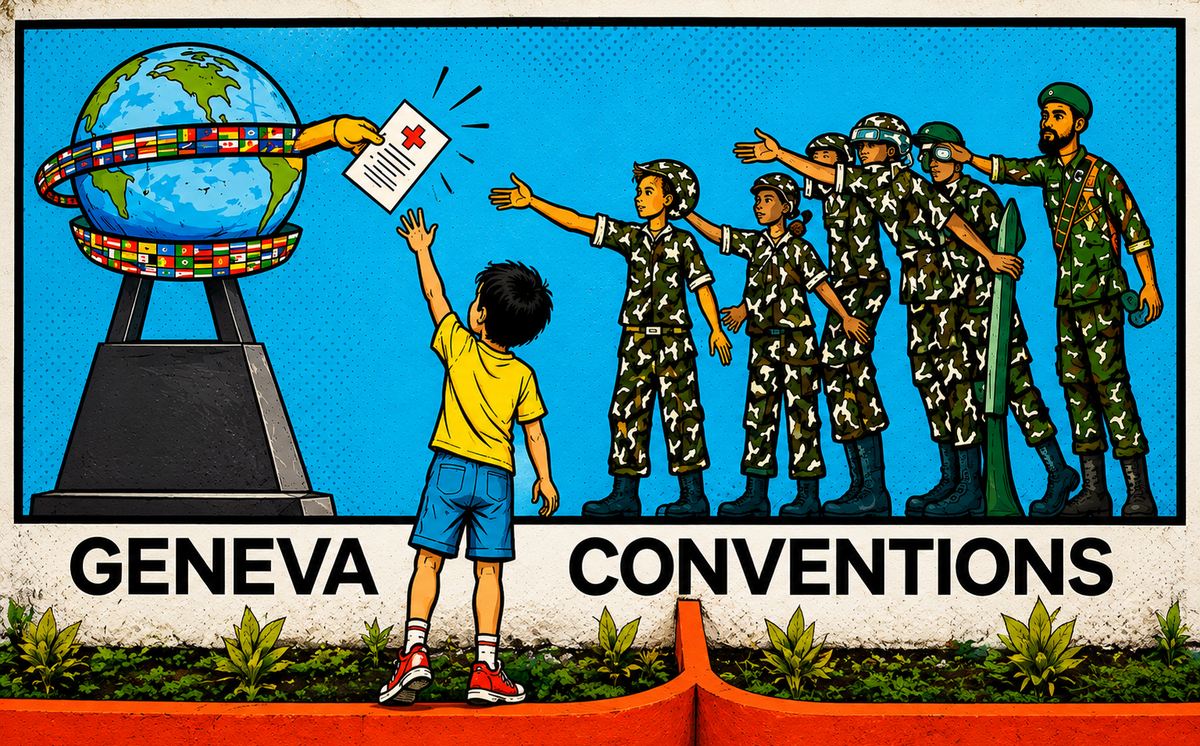
Today's topic
War has been a constant stain throughout our darkest moments.
For most of history, civilians were caught in the crossfire in battle, but as warfare became more destructive along came greater efforts to minimize fall out.
The first push we saw towards modern humanitarian law came after the 1859 Battle of Solferino in northern Italy, leading to the creation of the International Committee of the Red Cross, laying ground for the introduction of humanity in war.¹
The First Geneva Convention - 1864
- Introduced the notion wounded soldiers should be treated humanely regardless of which side they fought for.¹
- The Red Cross symbol as a protected emblem for medical personnel.²
Why the Modern Geneva Conventions Were Created - 1949
A major driving force behind its support was laid out following the devastation of World War II, which exposed massive failures in protecting civilians and prisoners.³
The Geneva Conventions protect:
- Wounded soldiers
- Prisoners of war
- Civilians
- Medical personnel and hospitals³
Together, these conventions established that even during war, there are limits to what nations can do.
It was expanded through additional protocols. Making way for the concepts that are heavily discussed:³
- Distinction: Civilians and military targets must be distinguished.
- Proportionality: Expected civilian harm cannot be excessive relative to the anticipated military advantage.
- Precaution: Militaries must take feasible steps to minimize civilian harm.⁴
Today, nearly every country on Earth agrees to those rules. The question is whether they are being followed, should there be flexibility in the interpretations, and who is held accountable when they are not.³
Consistent Enforcement Protects International Law
International humanitarian law only works if every country is held to the same standard.
What Supporters Argue
- International law loses credibility when enforced selectively.
- Civilian casualties should be investigated regardless of who caused them.
- Military aid can be used to encourage compliance with humanitarian law.
Progressive politicians tend to emphasize humanitarian protections. Senator Chris Van Hollen (D) has advocated for requiring countries receiving U.S. assistance to comply with international humanitarian law.⁵
In 2024, Van Hollen introduced an amendment that would require countries receiving U.S. military assistance to: Use U.S. weapons in accordance with international humanitarian law, cooperate with humanitarian aid efforts, and report on compliance to Congress.⁵
Modern Warfare Requires Flexibility
The Geneva Conventions remain essential, but today's wars are far more complex than those envisioned in 1949.
What Supporters Argue
- Armed groups often operate in densely populated civilian areas.
- Commanders frequently make decisions with incomplete intelligence.
- International organizations may not always have access to battlefield context.
This perspective is reflected in U.S. military doctrine. The Department of Defense's Law of War Manual acknowledges that proportionality judgments can involve "difficult and subjective comparisons" and does not require military operations to cause zero civilian casualties.⁶
Politically, Senator Tom Cotton (R) has shared a more forceful version of this argument, particularly in defending Israel's military efforts, arguing that Hamas's practice of operating among civilians complicates efforts to prevent civilian casualties.⁷
Why this matters today
The debate over the Geneva Conventions isn't theoretical. Alleged violations are at the center of several of today's largest conflicts.
Ukraine: The UN Human Rights Monitoring Mission has documented repeated Russian attacks on Ukraine's energy infrastructure, bringing major disruptions to civilian life.⁸ Based on documented attacks against civilian objects and excessive harm to civilians, the International Criminal Court has issued arrest warrants for several Russian military officials. Russia has rejected the ICC's jurisdiction and allegations against its officials.⁹
Gaza: The International Criminal Court issued arrest warrants for Israeli Prime Minister Benjamin Netanyahu and former Defense Minister Yoav Gallant, finding grounds to believe they bear responsibility for alleged war crimes, including starvation as a method of warfare and attacks directed at civilians. Israel rejects the allegations and the ICC's jurisdiction, maintaining that its military operations target Hamas and comply with international law.¹⁰
Sudan: A UN Fact-Finding Mission has concluded that both the Sudanese Armed Forces (SAF) and Rapid Support Forces (RSF) have committed large-scale attacks against civilians and destroyed essential infrastructure.¹¹ The UN has documented additional alleged war crimes by the RSF during its capture of El Fasher, while the ICC continues investigating alleged crimes committed in Darfur.¹² ¹³
Nibbles Take
Unlike traditional debates, very few prominent voices arguing against the Geneva Conventions themselves. The disagreement is in how they should be interpreted and what enforcement looks like.
- One vision sees the Conventions as a legal framework that must be enforced consistently to preserve legitimacy.
- Another vision sees it as essential rules that should be interpreted in light of the practical realities of modern warfare.
While I lean toward the first perspective, I recognize every conflict contains moral and legal gray areas. Regardless of the interpretation, what does enforcement look like?
Enforcement
Many assume there is an international police force enforcing the Geneva Conventions.There isn't. Enforcement relies strongly on governments being willing to pressure allies and adversaries alike by imposing sanctions and restricting arms transfers.¹⁴
Other Enforcement Mechanisms exist but are far less reliable.
- The Red Cross who monitors conflicts and advocates for compliance.
- The International Criminal Court can prosecute some war crimes.
- The United Nations Security Council has the ability to take action but is often blocked by vetoes.
Responsibility
One area where I lean more strongly is the role of the United States. As one of the world's leading military powers and one of the largest suppliers of military assistance to allies, I believe the U.S. has a greater responsibility to encourage compliance with international law.
That doesn't mean the United States is responsible for every action taken by its allies; it does mean we have leverage that many other nations do not.
A major rollback in our ability to do so came when President Trump rescinded Biden’s National Security Memorandum 20 (NSM-20) policy, requiring recipients of U.S. military assistance to provide written assurances that they would use American weapons in accordance with international humanitarian law.¹⁵
What might the future look like?
It’s complicated.
Modern warfare is changing in front of our eyes. We’re seeing the evolution of drones, AI, and cyber operations in real time, coupled with the involvement of non-state actors have made the battlefield much more complex. But at the same time, advances in surveillance technology, precision weapons, and intelligence gathering have raised public expectations that civilian casualties should be far less common today.
Unlike the past, every major incident is documented and debated in real time, making accountability more important than ever before by nations' internal governments and world powers like the United States.
Today, almost every country has agreed that war needs rules; whether nations are willing to enforce them when doing so conflicts with their own strategic interests decides how conflicts are resolved going forward.
Sources
- International Committee of the Red Cross — History of the ICRC
- International Committee of the Red Cross — Red Cross emblem
- International Committee of the Red Cross — Geneva Conventions and customary law
- U.S. Department of Defense — Law of War guidance
- Senators' 2024 humanitarian-law amendment
- U.S. military doctrine on proportionality
- Senator Tom Cotton — CBS Face the Nation interview
- UN Human Rights Monitoring Mission in Ukraine — June 2026 report
- International Criminal Court — Situation in Ukraine
- International Criminal Court — Situation in Palestine
- United Nations — Sudan Fact-Finding Mission
- UN Human Rights Office — El Fasher
- International Criminal Court — Darfur
- International Committee of the Red Cross — Ensuring respect for IHL
- NSM-20 rescission

Comments ()