
How a Regional Fight Could Reshape Global Power
Overview
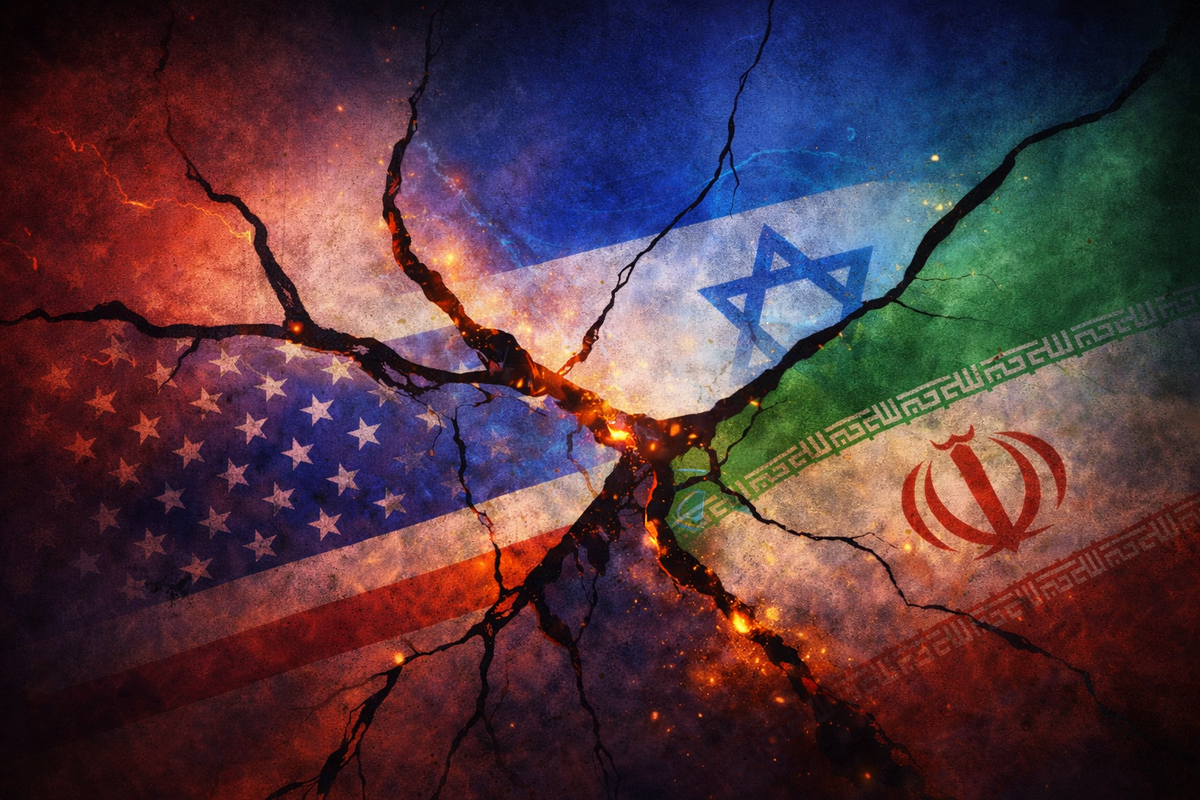
Feb 28th marked a major shift in U.S.—Iran relations.
With support from U.S. intelligence, Israeli forces struck Tehran in an operation that killed Iran’s supreme leader, Ayatollah Ali Khamenei, triggering a major leadership crisis not seen in the country since the 1979 revolution.
The reasoning behind the attack has several layers, but the main justification offered by Israel and the United States centers on security. U.S. and Israeli government states the strikes were necessary to:
- Prevent Iran from developing nuclear weapons.
- Limit growing ballistic missile arsenal.
- Weaken what they describe as Iran’s network of regional militant allies, including Hezbollah in Lebanon and Hamas in Gaza.
Regardless of what justifications put forth, the death of Iran’s leader carries major global implications. What has been raised include possibilities of wider warfare, disruptions to world energy markets, and shifts in geopolitical alliances.
What the United States and Israel Are Saying
Leaders of both countries have argued the strikes are necessary to stop Iran’s growing threat.
President Donald Trump - “Iran was weeks away from a nuclear weapon. We could not allow that to happen.”¹
Israeli Prime Minister Benjamin Netanyahu - “Iran’s nuclear program is an existential threat to Israel and to the world.”²
Further, the U.S. State Department has stated that “Iran’s missile and drone attacks across the region represent a dangerous escalation and a direct threat to international stability.”³
Public opinion:
U.S.
- 53% of voters oppose the U.S. military action against Iran, while 40% support it.⁴
- 74% of voters oppose sending U.S. ground troops into Iran, while 20% support it.⁴
Israel
- 93% of the Jewish Israelis support the operation, compared to 26% of the Arab citizens.⁵
- 64% of the Israeli public trust Netanyahu to manage the operation (74% of the Jewish citizens and 16% of the Arabs citizens)⁵
What Iran Is Saying
Iran’s government views their part in the conflict as rooted in self-defense against foreign aggression and defending its legitimacy recognized under international law.
Former Supreme Leader Ali Khamenei (before his reported death) - “The Zionist regime and its supporters will receive a severe punishment.”⁶
Iranian Foreign Ministry statement - “The United States has committed a flagrant violation of Iran’s sovereignty and international law.”⁷
Iran’s new leader, Mojtaba Khamenei has since warned that Iran will continue resisting U.S. and Israeli attacks.
Public opinion inside Iran is difficult to measure because of wartime censorship. However, a survey was conducted by GAMAAN at the end of September 2025, with over 30,000 Iranians regarding the Iran-Israel war.
- 44% believe that the Iranian government is responsible for starting the war, with 33% blaming Israel.
- 63% believe that the war was between Israel and the Iranian government, not against the Iranian people.⁸
Global reaction
Europe
Countries like France, Germany, and the United Kingdom remain aligned with the U.S., but have emphasized the need for de-escalation. Leaders have expressed concern about the risk of a wider war, disruptions to global oil supplies, and the humanitarian impact of the conflict.
Russia
Russia has strongly criticized the strikes to Iran, with officials arguing the attacks risks destabilizing the region. Having partnered through arms and energy deals with Iran they remain diplomatically aligned, though it has not entered the conflict militarily.
China
China has called for negotiations while avoiding direct involvement. With major economic interests in the region including large-scale oil imports and a strategic partnership with Iran. China has signaled sympathy toward Iran’s position, while emphasizing the importance of stability and the continued flow of global trade.
Nibbles Take
First I want to recognize that there have been internal protests and public dissatisfaction with the current Iranian regime. But, that does not mean our intervention is supported or trusted by citizens from either side.
Looking back at our record of military actions in the Middle East, it raises difficult questions about the long-term costs and outcomes we should expect.
Past war efforts:
Monetary Cost
- Roughly $8 trillion spent on post-9/11 wars in Iraq, Afghanistan, Syria, Pakistan, and other operations.⁹
- An additional $2.2–$2.5 trillion projected for veterans’ care by 2050.⁹
Human Cost
- 7,053 U.S. service members killed and over 50,000 wounded.⁹
- Over 900,000 people killed in post-9/11 wars and 4.5–4.7 million deaths from war-related causes (famine, disease, and infrastructure collapse)⁹
- 38 million people displaced by these conflicts⁹
Many Americans are already skeptical about our current involvement. Estimates suggest the war has already cost tax payers up to $15 billion, with 13 U.S. service members killed and another 150 troops wounded.¹⁰
Questions about the cost of war are resurfacing as the United States continues to face major domestic challenges. Even President Trump campaigned in part on avoiding new foreign conflicts and reducing America’s role in what he called “endless wars”
There is also a strong economic argument to consider. U.S. involvement in the conflict has increased pressure on the Strait of Hormuz, a critical chokepoint through where roughly 20% of the world’s oil supply passes.¹¹
Iran has not fully closed the strait as of now, but the threat of disruption is very real. Increased military presence, warnings to commercial ships, and attacks have already made the route much more dangerous. In global markets, perception matters almost as much as action— even the thought of disturbance can slow shipping and drive prices higher.
Oil prices have already risen, and if the Strait of Hormuz were to be fully blocked, prices could surge further. The effects would extend beyond energy markets and we could expect:
- higher gas prices
- increased shipping and transportation costs
- rising inflation globally
Beyond prices, there is another important aspect to consider. Iran has reportedly explored allowing certain oil shipments through the strait only if they are conducted in Chinese yuan rather than U.S. dollars.
This is beyond payment methods, it represents a broader shift. Oil has traditionally been traded in U.S. dollars, and any move away challenges the dominance of the dollar in global markets. Iran already conducts some oil trade with China and Japan using the Chinese yuan.
If expanded, we could see a sharp rise regarding China’s role within the global energy markets while the dollar drops in influence.
As of now, there are no clear resolutions ahead of us.
The closest sign of de-escalation we’ve seen from President Trump was a slight diplomatic effort when he delayed certain strikes. However, Iranian officials deny negotiations are underway. At the same time, military operations continue to be carried out, with major cities in both Iran and Israel being targeted as well as U.S. bases in the region.
While this conflict is complex, there is one simple fact in sight: we must remain hyper-conscious of our track record in the Middle East when thinking about what comes next. If we’re not strategic with our involvement, price hikes and energy disruptions may only be the beginning of a much darker path.
- Trump quote (Iran weeks away from nuclear weapon)
- Netanyahu quote (existential threat)
- U.S. State Department statement
- U.S. public opinion polling (Quinnipiac / YouGov)
- Israeli public opinion polling
- Khamenei quote / retaliation warning
- Iranian Foreign Ministry / sovereignty condemnation
- GAMAAN Iran public opinion survey
- Costs of War Project (Brown University)
- Cost + casualties (current Iran conflict)
- Strait of Hormuz oil-flow data

Comments ()