
Trading Trust: Can Congress Win Back Americans' Trust?
Overview
In 2025, the divide between our two major parties has grown sharper than ever. Yet there remain only a handful of issues where common ground can be found. One of them being the push to end the controversial stock-trading practices of elected officials.
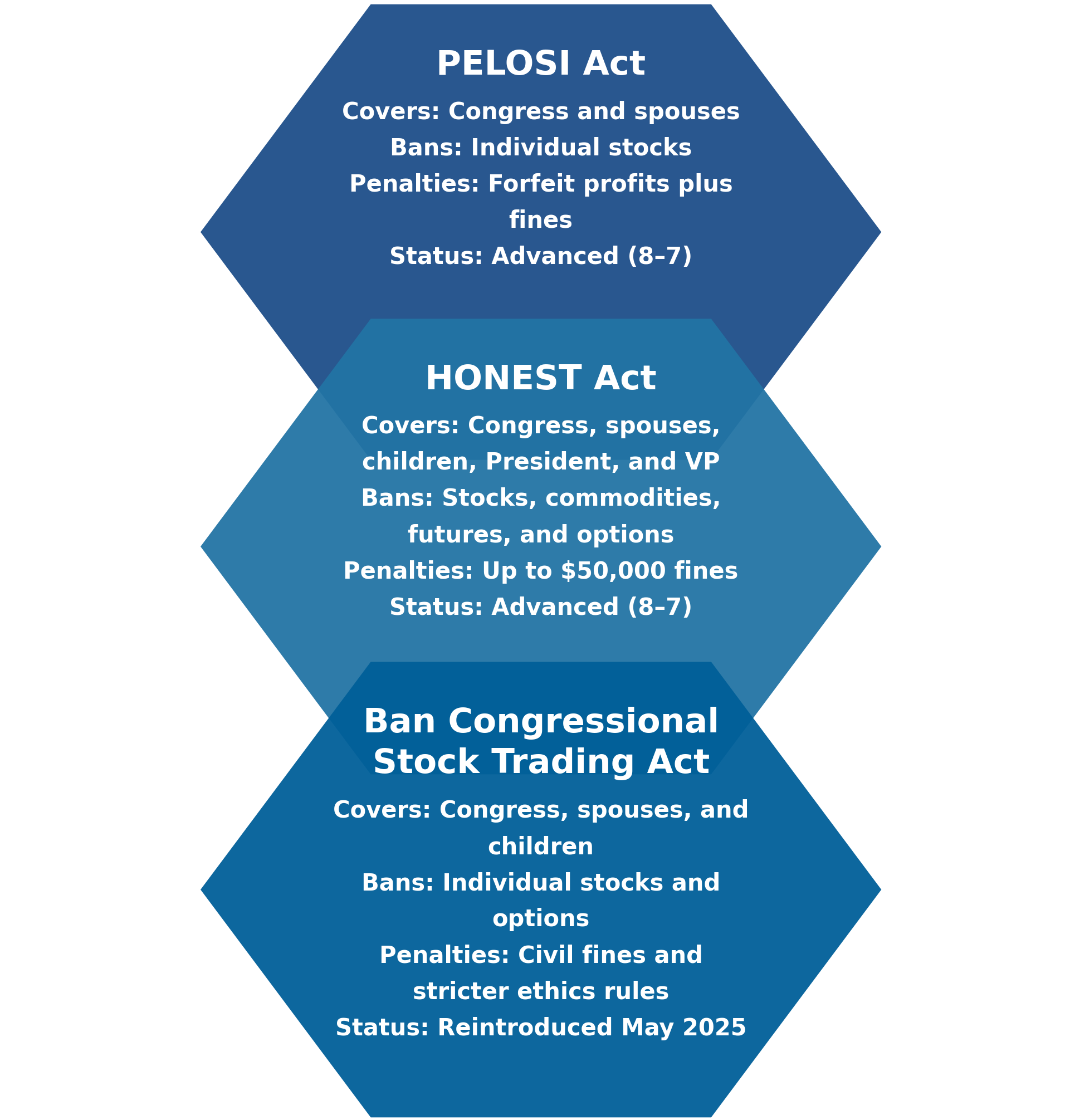
Both Republican and Democratic lawmakers have introduced different proposals aimed at restoring public trust, the big three being discussed included the PELOSI Act, HONEST Act, and Ban Congressional Stock Trading Act.
Before jumping into who's for and against these bills, let's break down how they will affect the way our politicians invest.
Supporters
Arguments for the reform include public distrust, curbing conflicts of interest, and closing loopholes in the current STOCK Act (2012), which bans insider trading but carries only a $200 fine for disclosure violations.¹
Key Actions Taken
- Sen. Mark Kelly (D–AZ) & Sen. Jon Ossoff (D–GA): Reintroduced the Ban Congressional Stock Trading Act.²
- Sen. Josh Hawley (R–MO): Crossed party lines by voting with Democrats in the Senate Homeland Security & Governmental Affairs Committee to advance the PELOSI Act.³
- The Bipartisan Trio: Rep. Chip Roy (R–TX), Rep. Alexandria Ocasio-Cortez (D–NY), and Rep. Seth Magaziner (D–RI) are working on a compromise bill that aims to merge elements from competing bills into a unified proposal.⁴
And when it comes to public opinion? 86 percent of Americans, across party lines, say Congress should crack down on lawmakers’ stock trading. That kind of consensus has fueled a rare burst of bipartisan cooperation on Capitol Hill.⁵
Opposition
Arguments against the ban have been relatively scarce, with fewer than a dozen lawmakers, mostly Republicans, publicly voicing opposition to the stock-trading proposals. Their concerns include government overreach and claims that the legislation unfairly targets President Trump, who has yet to put out any major public statement.⁶
Concerns and Action
- Sen. Rand Paul (R–KY): Criticized the bill as “heavy-handed” and warned it could prevent wealthy individuals, like future presidents, from holding assets.
- Voting “No” in Committee: All Republicans on the Senate Homeland Security & Governmental Affairs Committee (except Hawley) voted against advancing the PELOSI Act, showing organized opposition.⁷
- Speaker Mike Johnson (R–LA): Has so far refused to schedule a House floor vote, even though bipartisan pressure is mounting.⁸
While opposition is limited, their resistance highlights a lingering tension between reform and concerns over government overreach.
Nibbles Take
Much like the public, I believe these reforms are long overdue. For years we’ve watched members of Congress post stock returns that outpace major Wall Street firms.
One of the most prominent examples is Nancy Pelosi, whose portfolio posted returns of roughly 54% between 2024 and 2025. While her trades were technically legal, as she followed the 45-day disclosure window required by the STOCK Act, they were far from controversy-free.⁹
Some Pelosi family trades (especially in big tech stocks like Nvidia, Apple, and Alphabet) lined up with congressional activity on issues like antitrust, semiconductor subsidies, and defense contracts.
I’m not suggesting Pelosi can’t be a skilled investor, but her returns were nearly double those of Warren Buffett, long considered one of the greatest investors of our time. It raises questions: is this her innate talent, or does it give weight to the suspicion that lawmakers may benefit from “insider knowledge”?
Other figures who helped inspire these reforms
- Former Senators Richard Burr (R–NC) and Kelly Loeffler (R–GA), both of whom sold and bought millions in stock after receiving confidential COVID briefings.¹⁰ ¹¹
- Rep. Josh Gottheimer (D–NJ) has been dubbed Congress’s “busiest trader,” logging more than 500 trades worth $91 million in 2024-25. ¹²
Is it fair to limit lawmakers? I’d argue yes. Elected officials will still be able to invest, but under rules much closer to what ordinary Americans face: broad index funds, mutual funds, or blind trusts, rather than playing the market with privileged access.
For me, this isn’t about left or right. It’s about trust, and whether lawmakers are willing to play by the same rules as the rest of us. And with a starting salary of $174,000 I think they'll be just fine.
- Investopedia – STOCK Act: What It Is, How It Works, History
- Business Insider – Reintroduce Ban Congressional Stock Trading Act
- Axios – Josh Hawley crosses GOP lines to advance PELOSI Act
- NPR – AOC, Chip Roy, and Seth Magaziner push compromise
- PublicConsultation – 86% of Americans back stock-trading ban for Congress
- Axios – GOP resistance to stock-trading ban (July 2025)
- NYPost – Senate committee Republicans vote “no” on advancing PELOSI Act
- Axios – House Speaker Mike Johnson stalls vote on stock-trading ban
- YahooFinance – Pelosi’s portfolio outpaces Wall Street
- Propublica – Senator Richard Burr’s stock sales after COVID briefing
- NPR – Senator Kelly Loeffler’s controversial COVID-era stock trades
- Quiverquant – Rep. Josh Gottheimer dubbed “busiest trader”