Silicon Diplomacy: U.S. Links Nvidia H20 Chip Sales to Rare-Earth Trade
Overview
This July, the Trump administration reversed its export restriction, allowing U.S. tech company Nvidia to resume exporting its H20 AI chips to China¹.
The policy shift is closely tied to negotiations over rare-earth minerals, with China offering access to critical materials in exchange for access to the H20 chip². These minerals are essential to everything from clean energy to defense and aerospace.
The move signals a pivot from a security-first export control strategy to a more bargain-driven approach. Supporters argue it's a smart way to regain trade leverage and support American business. Critics call it a dangerous concession that could accelerate China’s tech and military ambitions.
Supporters’ Take – Economic & Diplomatic Strategy
Corporate Competitiveness
- Nvidia defended the move: “The H20 helps America win the support of developers worldwide… it does not enhance anyone’s military capabilities, and the U.S. government has full visibility and authority over every H20 transaction.³”
- National Economic Adviser Kevin Hassett added: “If China’s not buying chips from us, then they’re innovating… We don’t want them to jump ahead in chip development.”
Market Momentum Investors reacted positively to the export reversal: Nvidia’s stock briefly rallied as analysts noted its return to one of its largest markets could bolster earnings⁴.
On top of that, the company has reportedly placed a substantial 300,000-unit order with TSMC to meet rising demand from Chinese data centers a clear signal that this deal is already turning into real business, not just headline diplomacy⁵.
Critics’ Take – National Security Red Flags
Undermining Export Controls
- Vox warns that although the H20 is technically weaker than the H100, it remains powerful and cheap a “major advantage” that could close the AI gap⁶.
- A bipartisan group of 20 national security experts called the policy change a “strategic misstep,” urging the administration to reverse it over fears of enabling China’s AI-driven military and surveillance capabilities⁷.
Concerns from China over the new deal have also emerged. Beijing’s Cyberspace Administration has summoned Nvidia over alleged “serious security issues” in the H20 chip reportedly tied to fears the chip could be remotely tracked or disabled, a claim Nvidia strongly denies⁸.
Separately, in Washington, officials are considering both software and hardware location verification for export-controlled AI chips to curb smuggling. The idea is backed by bipartisan proposals as a way to tighten enforcement, while critics warn of higher costs and new cyber risks⁹.
Why China Still Wants U.S. Chips
Even though China is a global tech leader, its domestic chips are still behind in power, efficiency, and software support.
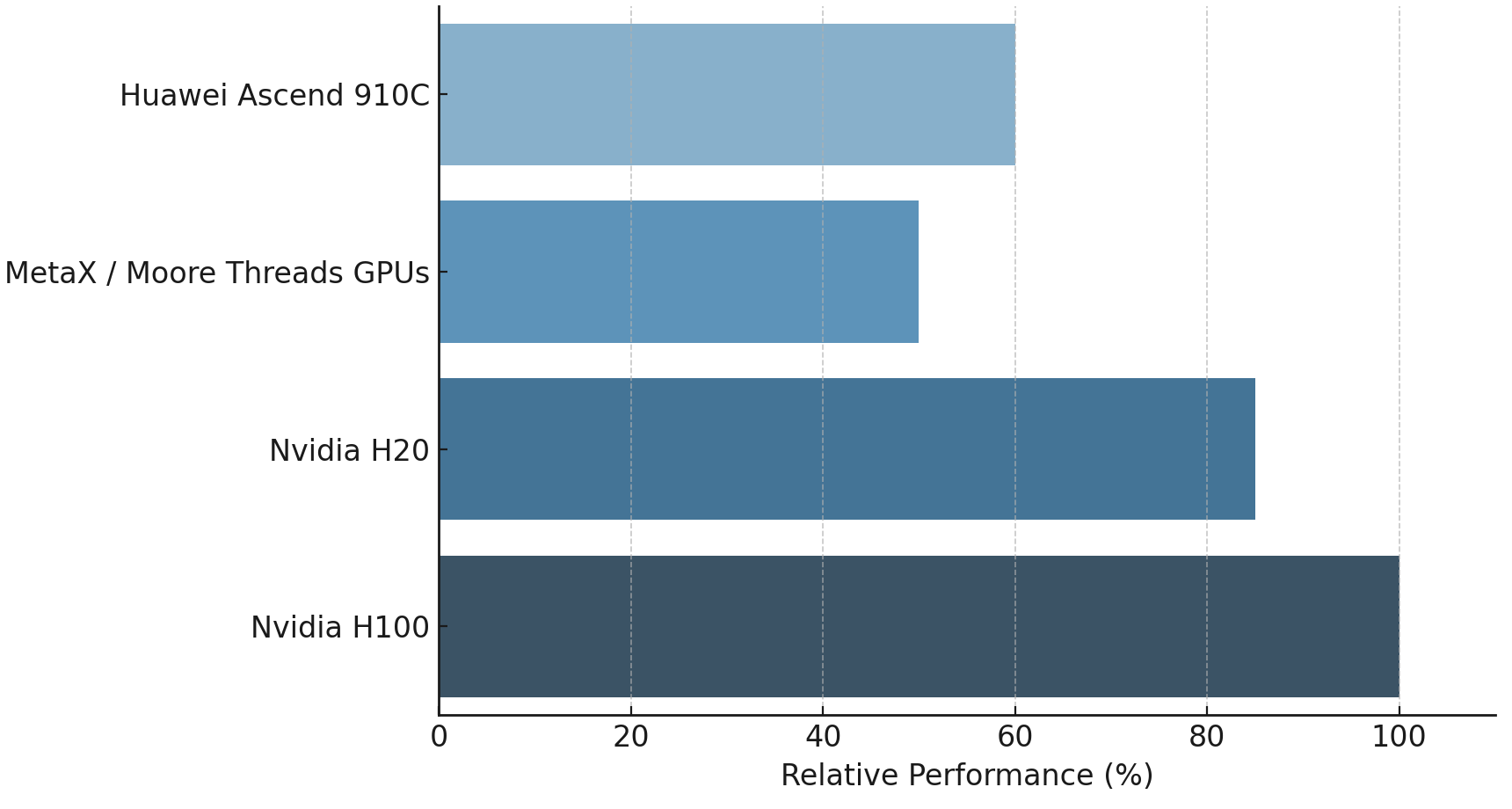
China’s best chip right now is the Huawei Ascend 910C.
- It performs at about 60% of what Nvidia’s top chip (the H100) can do¹⁰.
- Huawei built a giant server system (CloudMatrix 384) using hundreds of these chips to match Nvidia’s newest gear, but it consumes more than twice as much power¹¹.
Other Chinese chipmakers, like MetaX and Moore Threads, offer GPUs that reach around 50% of H100 performance¹².
Coupled with the fact that Chinese chips aren't fully compatible with Nvidia's CUDA platform, the global standard for building AI models, having access to Nvidia’s H20 chip (a mid-tier chip specifically designed to meet U.S. export restrictions) is still a major advantage for China’s AI market.
Nibbles Take:
Was This the Right Move by the current administration? I think so.
It’s no secret that China holds tremendous leverage over the global tech supply chain. The country produces roughly 69% of the world’s rare earth minerals and controls around 85% to 90% of global rare earth refining capacity, elements that are essential to everything from EV motors and smartphones to missiles and even AI chips¹³.
Aside from access to China’s rare earth resources, there’s also the massive financial blow to Nvidia to consider. Analysts estimate the company lost between $10 billion and $16 billion in revenue due to the export ban on its H20 chips¹⁴.
Despite the restrictions, nearly $1 billion worth of Nvidia’s banned AI chips were smuggled into China between May and July 2025¹⁵. This policy reversal could allow Nvidia to regain lost revenue while the U.S. reclaims a foothold in one of the world’s largest AI markets, a market already using Nvidia’s technology through backdoor channels.
What Can We Take Away From This?
It’s clear that trade restrictions alone aren’t an effective way to protect U.S. interests. If anything, they’ve shown how easily global demand can reroute itself through smuggling or black-market channels. More importantly, there’s something to learn from China’s approach: a willingness to embrace and integrate foreign innovation to strengthen its domestic industries.
Ironically, while Chinese companies continue to rely on our chips and software, many leading Chinese platforms and technologies remain off-limits to American consumers like Huawei mobile devices and Xiaomi’s smart cars (which outperform app integration, voice commands, and onboard AI compared to many U.S. smart vehicles).
As we debate how to secure our competitive edge, it’s worth asking: should openness and strategic engagement—not isolation—be our greatest advantage?
Endnotes
- Reuters — Nvidia resumes H20 chip exports to China
- Reuters — Nvidia resumes H20 chip exports to China
- Thenationalnews — Nvidia defends H20 GPU sales
- Yahoo Finance — Stock rises on H20 demand optimism
- Gurufocus — Nvidia orders 300,000 H20 chips from TSMC
- Vox — H20’s power and policy risks
- Times of India — Experts decry chip export
- Reuters — Nvidia denies backdoors amid China inquiries
- Bloomberg — Potential tracking raises risks
- Datacenterdynamics — Huawei’s Ascend 910C vs Nvidia
- Reuters — CloudMatrix 384 power inefficiency
- Wikipedia — MetaX and Moore Threads GPUs, Moore Threads
- USGS 2024 Rare Earth Mineral Summary
- AInvest — Estimated $10–16B revenue loss
- Financial Times - AI chips worth $1bn smuggled to China