
One Big Beautiful Bill: What’s to Come
Overview
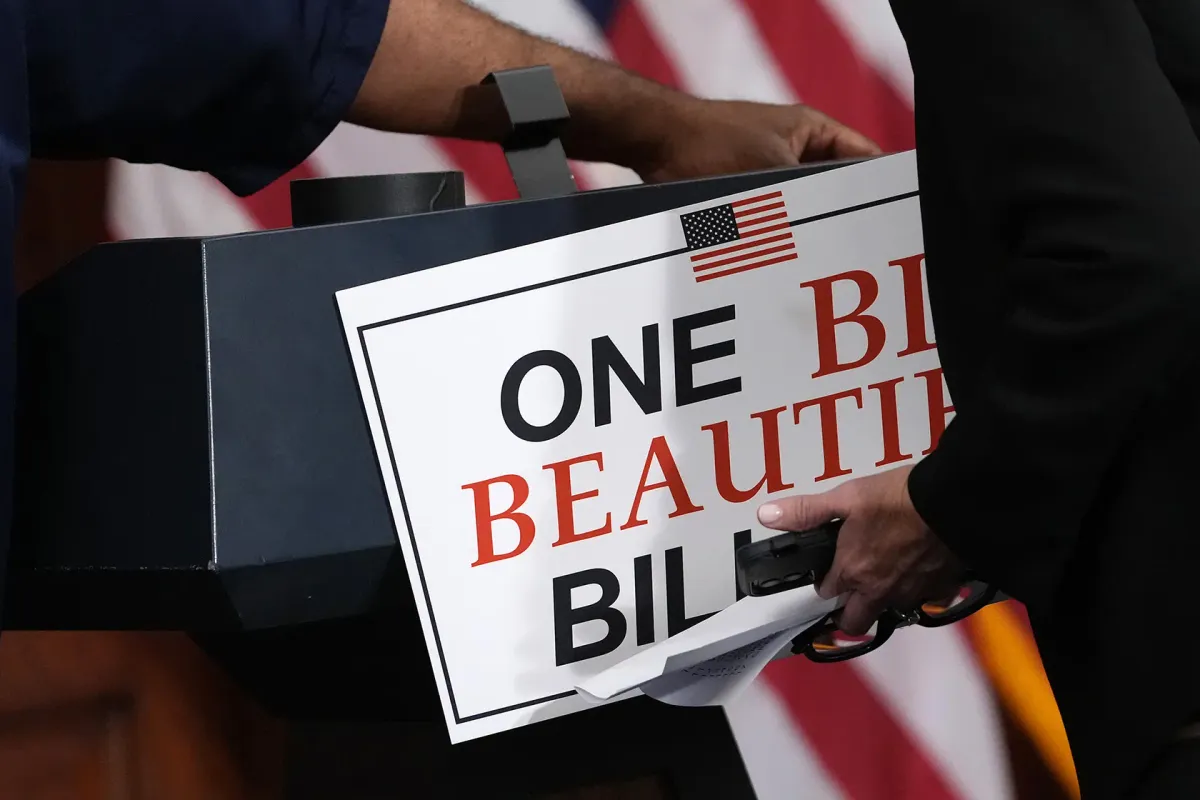
On July 4, 2025, President Trump signed the One Big Beautiful Bill into law, a sweeping $3.3 trillion package of tax cuts, border enforcement funding, and domestic spending reforms.¹
The bill aimed to cut federal spending, make Trump-era tax cuts permanent, and shift resources toward defense and border security, along with deep reductions to Medicaid, SNAP, clean energy incentives, and several federal agencies.²
Even the president's former advisor Elon Musk has voiced his concerns on the bill, saying “The latest Senate draft bill will destroy millions of jobs in America and cause immense strategic harm to our country.”³
What are both sides of the aisle saying? And more importantly, now that it’s officially law, the real question is what does it mean for everyday Americans?
Let’s break it down.
What The Right is Saying
On the right, the bill has sparked near-universal support, with only a handful of Republicans breaking ranks. It’s easy to see why: a package that offers corporate tax relief and beefs up defense spending hits two of the GOP’s biggest priorities.
Key Right Wing Supporters
- House Budget Chair Jodey Arrington (R‑TX) praised the bill as a “course correction” that would “balance the budget in ten years, rein in wasteful spending, strengthen work requirements, and secure the border.”⁴
- Speaker Mike Johnson (R‑LA) said “The One Big Beautiful Bill is a generational investment in American military might.”⁵
Dissent
While most Republicans backed the bill, five broke ranks over policy concerns, especially around Medicaid cuts, national debt, and inflation:
- Rand Paul (KY) acknowledged the bill would worsen the U.S. deficit.⁶
- Susan Collins (ME) warned Medicaid cuts would hit rural hospitals.⁶
- Thom Tillis (NC) pointed to hospital closures as a sign the cuts go too far.⁶
- Thomas Massie (KY) opposed it for fueling inflation and high interest rates.⁷
- Brian Fitzpatrick (PA) objected to the lack of safeguards for local healthcare providers.⁷
The dissent from a few within their own ranks shows that even longtime party priorities aren’t immune to pushback when the consequences hit too close to home.
What The Left is Saying
To no one’s surprise, Democrats voted in unison to oppose the bill, condemning the deep cuts to healthcare and food assistance, warning of serious impacts on low-income families and public health systems.
Key Left Wing Critics
- House Minority Leader Hakeem Jeffries (D–NY): “The Republican budget will set in motion the largest cut to Medicaid in American history.”⁸
- Gov. JB Pritzker (D–IL) worries that Roughly 330,000 Illinoisans could lose coverage and the consequences for rural hospitals would be catastrophic.⁹
Beyond healthcare democrats are concerned with:
- Roll back of EV and renewable energy tax credits.¹⁰
- Pell Grants tied to stricter credit-hour rules; part-time students at risk.¹¹
- Cuts funding for the Consumer Financial Protection Bureau.¹²
These changes could shift the burden to states, who may lack the financial capacity to continue these programs.
Senate Parliamentarians rule
Elizabeth MacDonough, the Senate Parliamentarian tasked with keeping unrelated agendas out of the bill, having removed or modified some of its more aggressive provisions. (examples below)
Struck Down from the Bill
- A GOP plan to shift SNAP (Food Stamps) costs onto states was struck for lacking a direct budget impact.¹³
- Provisions to repeal EPA regulations and fast-track fossil fuel permitting were also removed, ruled as purely regulatory and outside the scope of the bill.¹⁴
Modified to Stay in the Bill
- The repeal of EV and clean energy tax credits, originally immediate, was softened into a gradual phase-out through 2026 and 2027.¹⁵
- A national cap on Medicaid provider taxes was delayed until 2028 to ease the burden on state budgets.¹⁶
How will it affect Americans?
The bill permanently extends individual income tax cuts first passed in 2017, including:
- A larger standard deduction (roughly $15,000 for individuals, $30,000 for married couples.)¹⁷
- Cements many provisions of the Tax Cuts and Jobs Act of 2017.¹⁸
Tighter Rules for Benefits:
- New federal rules require most adults aged 19-64 to prove work, job training, or job-search activity with monthly reporting to retain Medicaid.¹⁹
- Work requirements now extend to parents of children over age 6 and adults over 50 (previously exempt) for SNAP (Food Stamps) benefits.²⁰
Military Funding Boost:
- The act includes $150 billion in new defense funding, marked for missile defense, shipbuilding, and combat aircraft.²¹
Nibbles Take
Over all this isn’t a bill I can see truly succeeding, and I say that as someone who genuinely believes government overspending is a problem.
When it comes to healthcare, I agree that our current system needs reevaluation. The U.S. spends nearly double per citizen compared to what other developed nations pay, yet outcomes don’t reflect that investment.²²
What I would have loved to see in this bill is a shift of funds to preventive care, starting with K-12 health and physical education. With more than a quarter of our healthcare spending going toward preventable illnesses, promoting healthier lifestyles early on should be an obvious long-term cost-saving strategy.²³
As for the repeal of EV and clean energy tax credits, I struggle to see the logic especially given President Trump’s campaign emphasis on revitalizing American manufacturing. These credits were helping U.S. companies compete in a fast-evolving global market.
We're already watching companies like Tesla lose ground to Chinese automakers like BYD and Xiaomi.²⁴ Can we really boost the U.S. economy in the long run by making it harder for American firms to succeed at home?
Another controversial sections in my opinion, is the bill’s push to promote what it calls “traditional American values” in K-12 education. It offers federal incentives to states and school districts that emphasize national pride, founding principles, and American exceptionalism.²⁵
Participation is optional but we can expect conservative states to benefit the most, as it is unlikely that liberal states will abandon their DEI-focused programs to qualify for the funding.²⁶ The result? A growing cultural divide in education, with students across the country inheriting increasingly polarized versions of history and identity depending on where they live.
One thing’s clear about this bill: it’s big. As for beautiful? That’s for Americans to decide.
- Congressional Budget Office score, July 2025
- Final text of the One Big Beautiful Bill, Title I–IV
- Elon Musk statement
- Statement by Rep. Arrington, House Budget Committee transcript
- Mike Johnson’s press release
- Republican Senators Who Voted Against Trump’s ‘Big Beautiful Bill’
- Thomas Massie and Brian Fitzpatrick ABC article
- Jeffries on Medicaid cuts
- Pritzker warns on Medicaid
- Clean Energy
- Education
- Regulations
- SNAP provisions removed
- Parliamentarian rulling on EPA
- Phase-out of green tax credits
- Medicaid tax deferral
- Individual tax cuts
- TCJA extensions and business tax relief
- Medicaid Work Requirement
- Snap Work requirements
- Increase Defense Funding
- OECD Health Spending per Capita, 2024 report
- CDC: Preventable Chronic Conditions and Costs Report
- Tesla losses Ground to Chinese EV Giants
- Traditional American values in K-12
- Education Changes