
Inflation Is Cooling. So Why Are Prices Still High?
Overview
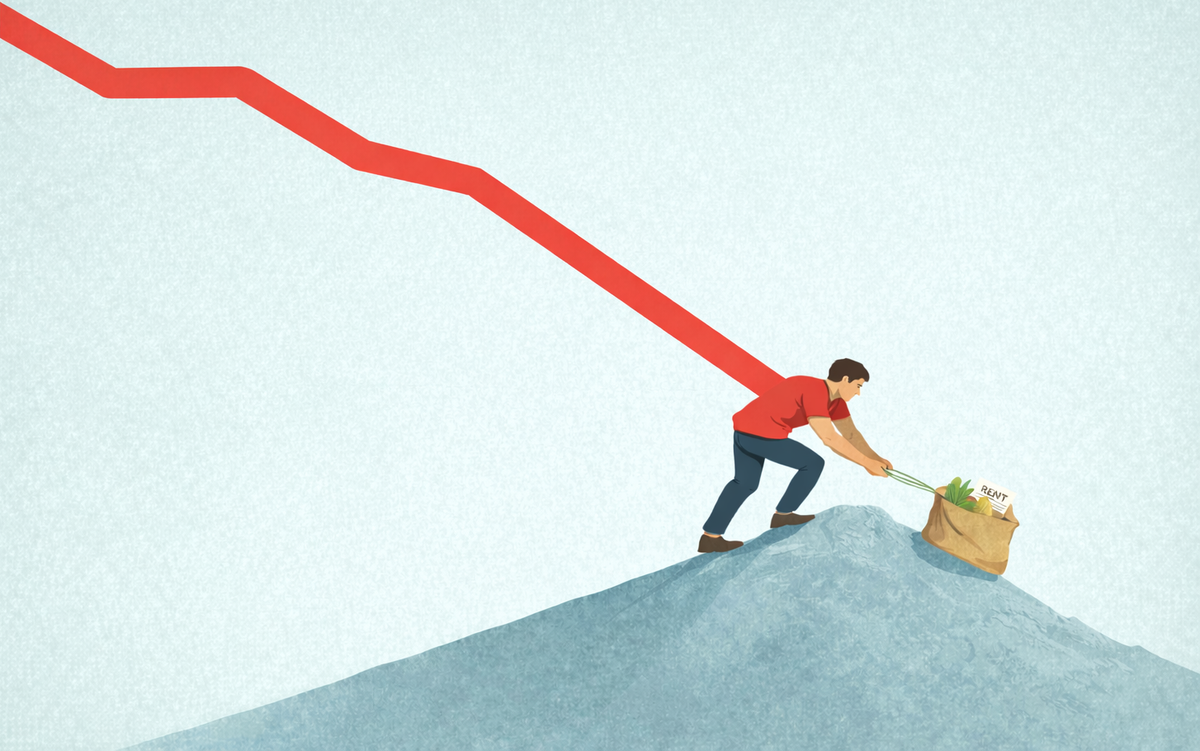
Inflation is down. So why are Americans still struggling to keep up?
Current inflation sits around 2 to 3 percent — a range economists generally consider healthy and stable.[1] That benchmark works because it signals that prices are no longer spiraling out of control, not because everyday life has become cheaper. What reassures economists — including those at the Federal Reserve — doesn’t always translate into relief at the grocery store.[2]
In short, falling inflation doesn’t mean prices come down — it means they stop rising as fast. After years of rapid increases, households are left paying yesterday’s surge with today’s paychecks.
It’s like slowing a car after miles of speeding. You’re no longer accelerating, but you’re still far from where you intended to be.
To understand why relief feels absent, it’s worth examining the gap between economic data and everyday experience — from the perspective of economists and American households.
The Economy Is Improving (By the Data)
By traditional indicators, the economy is stabilizing.
Inflation: The Consumer Price Index is rising around 2.7% year-over-year, close to the Federal Reserve’s 2% target.[1]
Wage Growth: Average hourly earnings are increasing at roughly 3.8% annually, modestly outpacing inflation.[3]
Unemployment: The unemployment rate stands near 4.4%, below the long-term historical average.[4]
Consumer Spending: Personal consumption — nearly 70% of GDP — has grown at approximately 3.5% annualized in recent quarters.[5]
From this view, the emergency phase is over.
Economists argue stabilization of price increases is the progress our country needs, and that deflation would signal economic contraction.[6]
The Economy Doesn’t Feel Better (For Real People)
Across the country, households are still feeling pressure. To many Americans, stabilization at a higher price level still feels like strain.
Groceries: Food-at-home prices remain roughly 25–30% higher than in 2019.[7]
Rent: National rent levels are still about 30% above pre-pandemic levels.[8]
Auto insurance: Costs have climbed more than 50% since 2019.[9]
Headline inflation reflects an average basket of goods. But households do not live in averages. They live in rent payments, groceries, and utility bills.
Today’s wage growth often covers yesterday’s surge. That feels less like progress and more like catching up.
Nibbles Take
The data doesn't lie. On paper, the economy is doing better.
But better than terrible is not the same as good.
Yes, inflation has slowed, but that doesn’t undo the sharp rise in prices that households already absorbed. Even raises and cost-of-living adjustments today seem to barely help families who are still adjusting to a higher baseline — and in some cases remain behind where their purchasing power stood before the pandemic.[10]
Aside from the inflation rate, additional financial pressures shape how households experience the economy.
Beyond inflation, the Consumer Price Index (CPI) does not directly account for borrowing costs such as:
- Credit card interest (average APRs have climbed above 20%)[11]
- Mortgage interest rates, which more than doubled from their pandemic-era lows[12]
It’s clear that Americans are feeling sustained financial pressure. So what now?
Saying what needs to happen is easier than making it happen.
At a basic level, relief requires sustained real wage growth — wages rising faster than inflation for multiple years, not just one quarter. If inflation remains near 2–3% and wage growth consistently exceeds that pace, purchasing power can gradually rebuild. But that recovery would be incremental, not immediate.
Another major variable is housing, as it makes up roughly one-third of the CPI and an even larger share of many household budgets.[13] Expanding housing supply, slowing rent growth, and stabilizing mortgage rates would likely do more to ease household strain than marginal improvements in the inflation rate.
If those conditions fail to take place, the risk is not economic collapse, but normalization of strain. Households may continue to rely on borrowing at elevated interest rates to maintain living standards, embedding higher debt burdens into everyday life.
But as a silver lining, there are actions being taken to move us in the right direction with real initiatives.
Efforts Around Wages
In 2026, 19 states and Washington, D.C., are raising their minimum wages, with many crossing the $15-per-hour threshold.[14]
At the federal level, proposals such as the Raise the Wage Act would gradually increase the minimum wage — potentially to around $17 per hour — and tie future increases to broader wage growth.[15] Though the legislation has not passed, it reflects ongoing debate over how to restore purchasing power for lower-income workers.
Efforts Around Housing
Housing policy is also receiving renewed attention. Proposals such as the Housing for the 21st Century Act aim to increase supply by streamlining regulations, expanding financing tools, and reducing construction barriers.[16]
Several states are experimenting with zoning reforms and permitting modernization to accelerate building and lower development costs. In New York, recent state budgets have included billions of dollars in capital funding to expand housing supply and address affordability pressures.[17]
While relief has been uneven, concrete efforts underway offer a path toward a more stable and sustainable future. With time and sustained progress, the economy may move from one of survival to one where more Americans can genuinely thrive.
Endnotes
[1] U.S. Bureau of Labor Statistics (BLS), Consumer Price Index Summary
[2] Federal Reserve, Statement on Longer-Run Goals and Monetary Policy Strategy (2% inflation target)
[3] U.S. Bureau of Labor Statistics, Average Hourly Earnings – Employment Situation Summary
[4] U.S. Bureau of Labor Statistics, Unemployment Rate Historical Data
[5] U.S. Bureau of Economic Analysis (BEA), Personal Consumption Expenditures & GDP Data
[6] Federal Reserve Bank of St. Louis, Inflation, Disinflation and Deflation
[7] U.S. Bureau of Labor Statistics, Food at Home CPI Index
[8] U.S. Bureau of Labor Statistics, Shelter Index (CPI)
[9] U.S. Bureau of Labor Statistics, Motor Vehicle Insurance Index
[10] Federal Reserve Bank of Atlanta, Wage Growth Tracker
[11] Federal Reserve Economic Data (FRED), Credit Card Interest Rates (APR)
[12] Freddie Mac, Primary Mortgage Market Survey (PMMS)
[13] U.S. Bureau of Labor Statistics, Relative Importance of Shelter in CPI
[14] Economic Policy Institute, Minimum Wage Tracker
[15] U.S. Congress, Raise the Wage Act (Bill Summary)
[16] Bipartisan Policy Center, Housing for the 21st Century Act Overview
[17] New York State Homes and Community Renewal, Housing Budget & Initiatives